What is kava?
Kava is a remarkable plant from the South Pacific, botanically fascinating, culturally significant across Oceania for thousands of years, and the source of distinctive natural pigments and aromatic compounds.
In accordance with EU regulations, our kavas are sold exclusively for aromatherapy and natural textile dyeing. Explore the sections below to learn more about the plant, its history, and its chemistry.
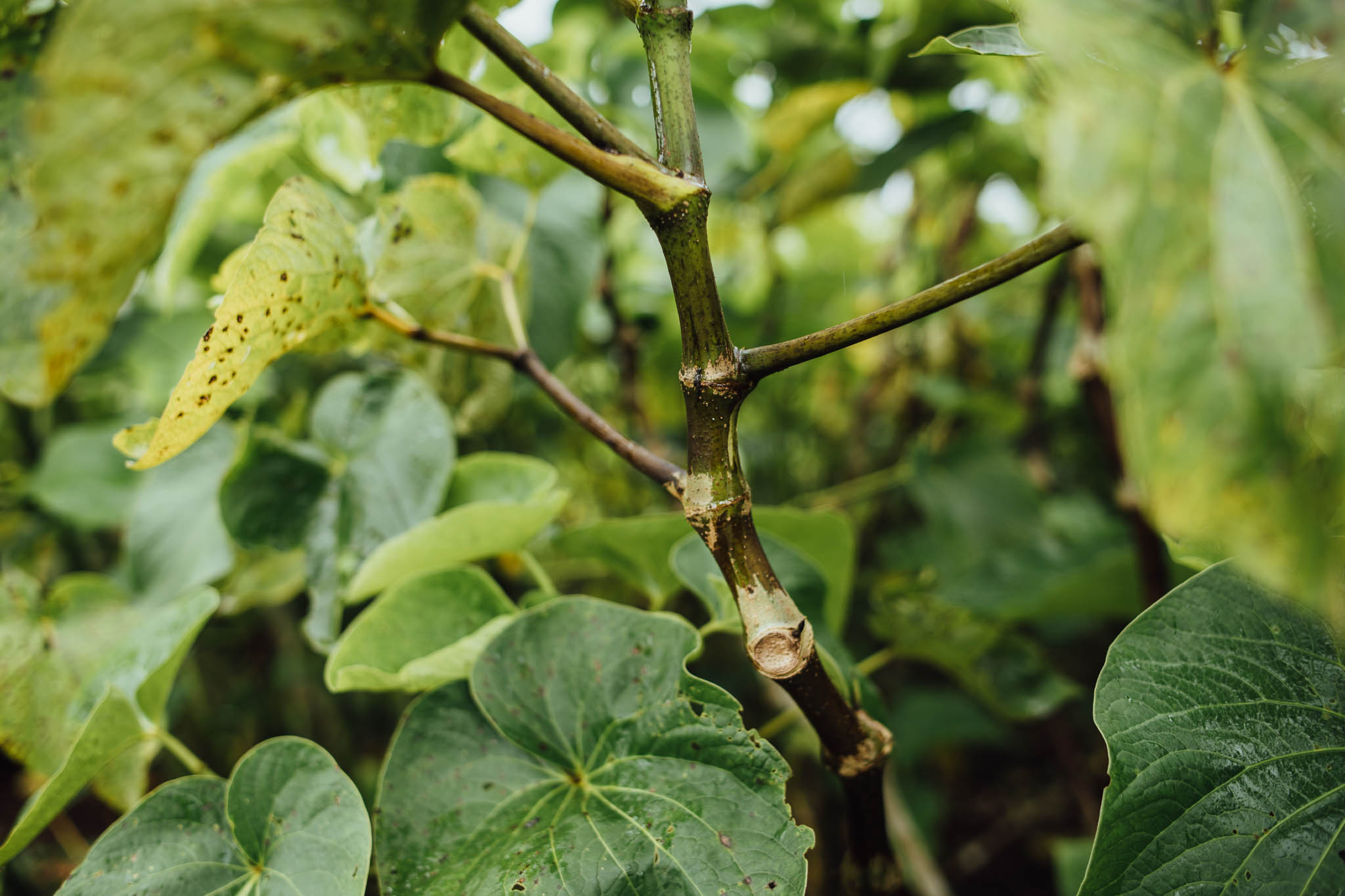
Kava (Piper methysticum) belongs to the pepper family Piperaceae, making it a distant relative of the black pepper in your kitchen. It grows as an attractive shrub reaching over three metres in height, with broad, heart-shaped leaves and thick, jointed stems. It thrives in the rich volcanic soils of islands like Vanuatu, where warm temperatures, high humidity, and clean mountain water create ideal growing conditions.
The valuable part of the plant is below ground. The rootstock and lateral roots, often called the laterals, develop into a substantial mass through traditional soil-mounding techniques. It is here that the plant’s unique phytochemicals concentrate. The above-ground stems and leaves contain very little of these compounds and are not used.
Kava is a slow grower. Quality roots require at least three to five years in the ground before harvest, with experienced farmers often leaving plants in the ground longer to develop greater root mass and richer chemistry.
One of kava’s most remarkable botanical features is that it is completely sterile. The plant cannot reproduce on its own. It produces no seed, and every kava plant in the world today must be propagated by human hands, through stem cuttings. This means that every noble cultivar is a direct genetic clone of an ancient original, maintained through generations of careful Pacific Island farming. In a very real sense, kava is a living botanical archive: a plant that exists only because thousands of years of human cultivators chose to keep it alive.
Vanuatu alone is home to more than 80 distinct noble cultivars, more than the rest of the Pacific combined.
Kava’s story begins in northern Vanuatu, an archipelago in the South Pacific made up of more than 80 islands. According to research by botanist Dr Vincent Lebot, kava was first domesticated there around 3,000 years ago, when early Pacific farmers encountered a natural mutation of a wild ancestor (Piper wichmannii) that produced more desirable characteristics than the wild species. Despite being harder to propagate, they preserved it carefully, passing cuttings from generation to generation.
From this origin point in northern Vanuatu, kava cultivation spread gradually across the Pacific over centuries, carried by Lapita seafaring peoples on voyaging canoes as one of their most prized cultivated plants. From Vanuatu it travelled south and east to Fiji, Tonga, Samoa, and onward through the Polynesian migration to the Cook Islands, Tahiti, the Marquesas, and eventually Hawaii at the easternmost edge of the Polynesian world.
Each island group developed its own varieties and cultural customs around the plant. The names varied: kava in Tonga and parts of Vanuatu, yaqona in Fiji, ‘awa in Hawaii, sakau in Pohnpei. The cultural significance was consistent. Kava became woven into the social fabric of Pacific life, present at important gatherings, at the marking of significant occasions, and as a symbol of welcome and peaceful exchange.
Vanuatu remains the heartland of kava culture today. It has more named cultivars than anywhere else in the world, and kava plays a central role in everyday social life. It is also where the world’s finest kava is grown, including the kava that Kava Europe sources exclusively through The Kava Society (New Zealand), whose Vanuatu partners have spent over a decade developing processing methods that preserve the authentic character of freshly harvested roots.
The roots of the kava plant contain a family of unique natural compounds called kavalactones, found nowhere else in the plant kingdom. There are six major kavalactones: kavain, dihydrokavain, methysticin, dihydromethysticin, yangonin, and desmethoxyyangonin. The relative concentration of these six compounds varies between cultivars and gives each its own distinctive character.
The cultivar’s chemical fingerprint is expressed as a chemotype: a six-digit number that ranks the major kavalactones in order of concentration. For example, a chemotype of 463512 means that kavain is the most abundant, followed by dihydrokavain, then yangonin, and so on. Different cultivars have different chemotypes, and Pacific Island farmers across the centuries have selected for chemotypes producing the most desirable characteristics.
Not all kava is equal. Over centuries of cultivation, Pacific Island farmers selected the most desirable kava varieties, those with favourable chemotypes and clean, consistent character. These carefully preserved varieties are known as noble cultivars. They represent the pinnacle of traditional kava cultivation. Vanuatu’s Kava Act (2002) legally restricts kava exports to noble cultivars only, protecting the country’s reputation for quality. Non-noble cultivars are excluded from our range.
The kavalactone content of the roots also determines the vibrancy of the natural pigments they produce, directly relevant for textile dyeing applications. Fresh-processed noble kava retains a distinctly richer colour profile than poorly dried alternatives, ranging from pale gold through warm caramel to deep chocolate-brown, depending on the cultivar and its chemotype.
In the European Union, our kavas are sold exclusively for aromatherapy and natural textile dyeing. Kava Europe operates fully within these regulations, supplying premium noble kava root for both purposes.
For aromatherapy, the dried roots carry a warm, woody-balsamic aroma with cultivar-specific character, clean and nutty, sometimes lightly spiced or faintly resinous, and can be used loose, in sachets, or infused into neutral fabric for scent work. For natural textile dyeing, the pigment-bearing compounds in kava root bind beautifully to cotton, linen, silk, and wool, producing a spectrum of warm earth tones from soft honey-amber through rich caramel to deep golden brown that vary by cultivar, concentration, and dwell time. The colours are entirely plant-derived and free from synthetic additives.
Further reading
Selected resources on kava’s botany, history, and chemistry, for those who want to explore the plant in greater depth.
Lebot, V., Merlin, M. & Lindstrom, L. (1992, revised 1997). Kava: The Pacific Elixir. Yale University Press / Healing Arts Press. The foundational academic reference on kava ethnobotany, history, and genetics. Co-authored by Dr Vincent Lebot, the world’s leading expert on kava botany.
Lebot, V. & Siméoni, P. (2019). Buveurs de Kava. A more recent work in French covering the contemporary state of kava cultivation, chemistry, and trade.
Dr Vincent Lebot’s research profile. Lebot is a botanist with the French Agricultural Research Centre for International Development (CIRAD), based in Vanuatu. He has spent decades studying kava’s botany, genetics, and cultivar classification, and his published research forms the foundation of modern scientific understanding of the plant. Google Scholar profile
The Kava Society (New Zealand). Our exclusive supplier in New Zealand. Their site offers extensive material on kava’s botany, history, culture, cultivation, processing, and chemistry, including detailed cultivar profiles and a public certificate-of-analysis database for every batch. kavasociety.nz
Vanuatu Kava Act (2002, amended 2015). The Vanuatu legal framework defining noble cultivars and restricting kava exports from Vanuatu to those varieties only. Establishes the international working definition of “noble” kava.