Understanding Kava Forms: From Fresh Roots to Dried Powders
For more than three thousand years, kava has been part of life across the Pacific. In Vanuatu, Fiji, Tonga, Samoa, and beyond, fresh kava roots have been pulled from the ground, cleaned, pounded, and worked with water within hours of harvest. The Pacific tradition is a fresh-root tradition.
Outside the Pacific, fresh kava is not available. The roots begin degrading within hours of harvest and cannot be transported far. This reality has produced a range of dried forms, each developed to capture as much of the fresh root’s character as possible. The two we offer are Traditional Grind and True Instant.
Kava Europe sells its products in accordance with EU regulations exclusively for aromatherapy and natural textile dyeing applications.
Traditional Grind
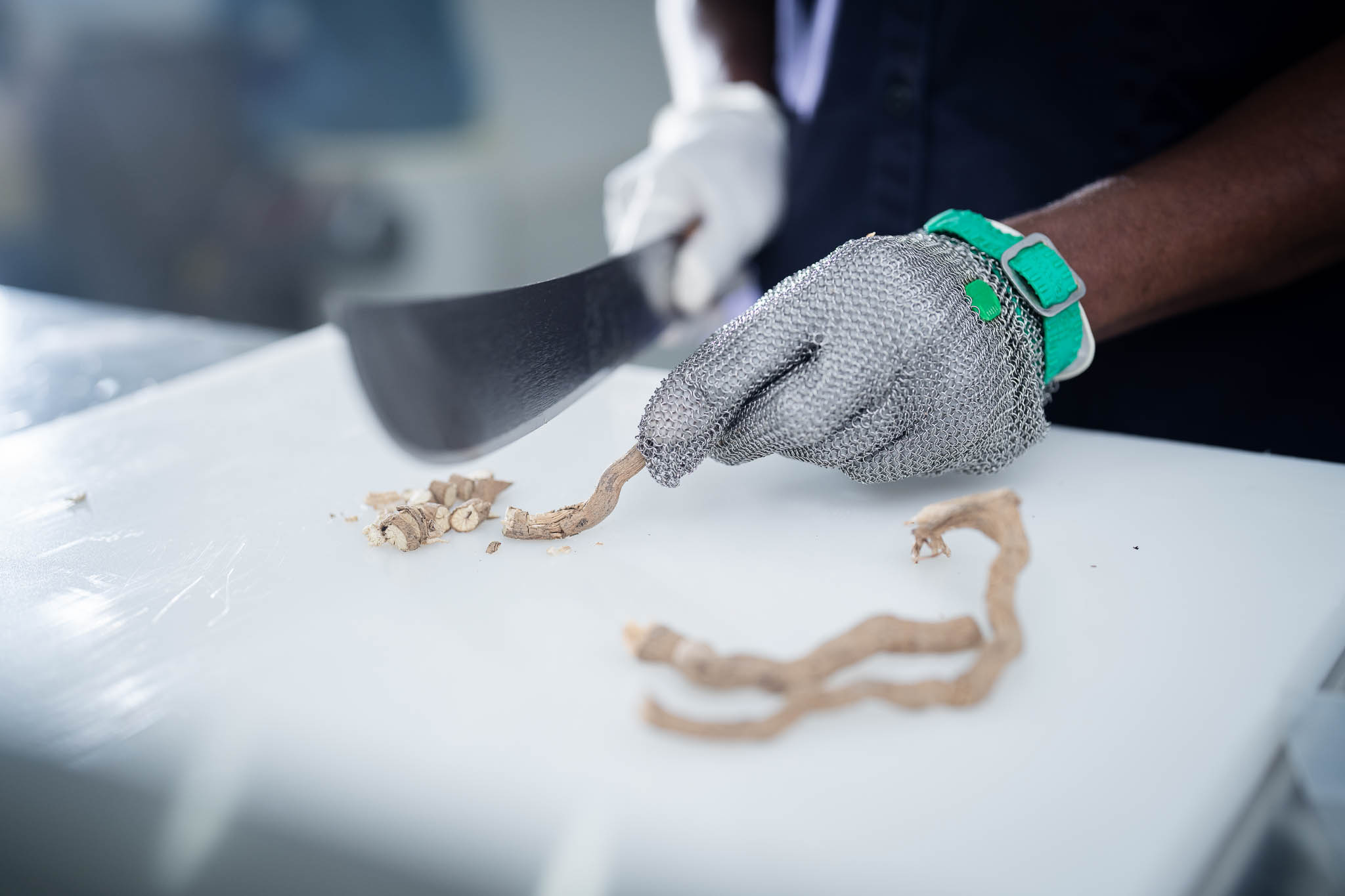
Traditional grind is the most widely known dried form of kava. Whole roots are washed, peeled, dried under temperature control, and ground to a medium-coarse powder. The result retains all of the plant’s fibrous material alongside the soluble root compounds.
Traditional grind keeps the full aromatic complexity of the dried root. The pigment ranges from honey gold to deep mahogany depending on the cultivar, and the aroma is fresh, peppery, and clean.
It is the more economical option per gram.
True Instant
True instant is a more recent development. Fresh kava roots, rather than dried ones, are processed with water to separate the soluble root fraction from the insoluble woody fibres. The resulting liquid is then carefully dehydrated into a fine, uniform powder.
Because kava is fundamentally a suspension of soluble root compounds in water, removing the fibres before drying produces the same root material that would otherwise need to be filtered out manually. The powder is concentrated, fibre-free, and reconstitutes cleanly in seconds.
The pigment load per gram is higher than traditional grind. Some of the lighter aromatic notes soften during the drying process, so the scent reads more subdued.
A Note on Micronised Kava
Some vendors sell micronised kava as instant kava. It is not the same. Micronised kava is simply traditional grind milled to a finer particle size. The fibres remain. We do not sell or recommend micronised kava, and consider it an inferior product.
Why Processing Quality Matters
Most commercial kava is dried on concrete slabs or tin roofs over days or weeks, exposed to dust, rain, and contamination. By the time it reaches market, the colours are dull and the aroma is stale.
We source our kava exclusively from the Kava Society, New Zealand’s specialist supplier of fresh-harvest noble kava. Their Vanuatu partners process roots within 24 hours of harvest using temperature-controlled dehydrators in HACCP-certified facilities. The difference is immediately apparent. The powder retains the distinct colour of each cultivar, ranging from pale honey to deep mahogany. The aroma is fresh and clean, with peppery, nutty, and herbaceous character depending on the cultivar.
“Most kava on the market is poorly dried and cleaned, often from roots of unknown cultivar origin. Our processing is built around freshly harvested noble kava, with full traceability and rigorous laboratory testing of every batch.” The Kava Society (New Zealand)
Quality Markers
The markers of kava quality are visible before any work begins:
- Colour vibrancy. Fresh-processed kava retains the distinct colour of each cultivar. Degraded kava turns uniformly grey-brown.
- Aroma. Quality kava smells fresh, peppery, and nutty. Poor-quality kava smells musty or like damp cardboard.
- Texture. Traditional grind should be a consistent medium texture. True instant should be fine and uniform, with no visible fibres.
- Laboratory testing. Every batch we sell includes a certificate of analysis covering chemotype, kavalactone content, and microbiological safety.
For deeper background on individual cultivars, chemotype analysis, and the Kava Society’s processing methods, see kavasociety.nz.